

Irene Gomez with maestro Miguel Angel Girollet and French guitarist Frederic Bergeret at Colmar

Irene Gomez with maestro Miguel Angel Girollet and French guitarist Frederic Bergeret at Colmar

Irene Gomez with professor Edward Klorman, Juilliard teacher
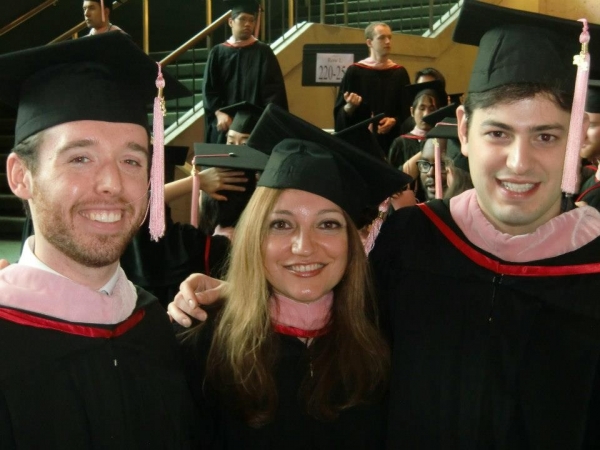
Irene Gomez the day of commencement ceremony with fellows Lucas Pullin and Colin Davin

Irene Gomez at the 90’s Birthday of Dr. Emanuel Horowitz

Irene Gomez with her friend guitarrist Gohar Vardanyan
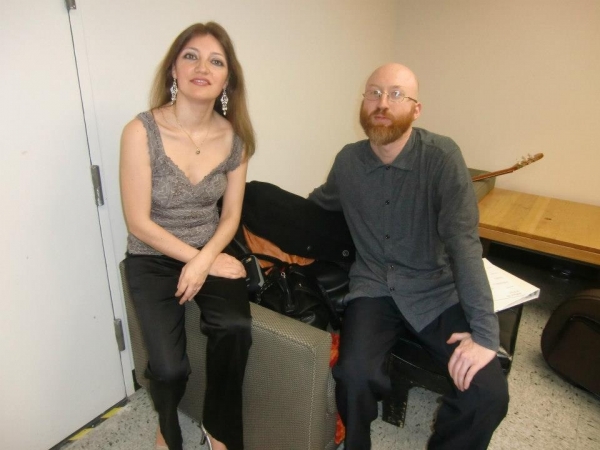
Irene Gomez with maestro Eduardo Fernández, María Stella Fernández, José Daniel Ramírez Combariza
written by Irene Gómez, specially written for the Strings By Mail Articles
Browse and shop Debussy related sheet music for pieces referenced in this article
Since the past two years I have brought to this section of Strings By Mail, relevant facts that have been important for the development of artistic, musical or even social thinking in our culture. This is why in 2016 we went through Shakespeare and Cervantes 400 years of passing away and the music of their time. Last year, we spoke about the commemoration of 500 years of Luther’s Reform and its influence in music. During this agitated 2018 we have to join through this space, the numerous celebrations that are being remembered through concert programs and all medias, the passing away of Claude Debussy 100 years ago and the birth of beloved Leonard Bernstein 100 hundred years ago. Many musicians are taking this year to bring up to audiences Bernstein’s important output, that during his life was somehow overshadowed by his genial conducting!

Irene Gomez
In order to give the deserved space to each one of them we will spread the anniversaries of this year into two articles, starting by Claude Debussy and hoping to bring soon a semblance of Leonard Bernstein in the next delivering. For now I hope you will enjoy refreshing some aspects of French composer Claude Debussy that are exposed below:
(b. August 22 1862 in Saint-Germain-en-Laye, d. March 25, 1918 in Paris)
Debussy lived during the period named “Belle Époque”, the time between the last years of the XIX century and 1914, just before the beginning of First World War. The “Belle Époque” was then the French name to designate a special attitude towards life leaned on certain frivolity, hope and the “joie de vivre”. The looking for freedom and auto-identity and somehow the growing interest for “exotic” cultures, the love for nature, and irreverence marked the spirit of those years. During these years many inventions that we know today were created (phone, movies, cars, the first planes).
It was a time of contrasts and ruptures giving birth to new schools of thinking. In the field of visual arts, The “Impressionists” left their classical practice focused in the form and perfection of shapes to turn into more subtle ways to express their vision of the world, which by the way was deeply enlarged. (Impressions, Soleil levant, by Claude Monet, was the work that by an ironic critic gave birth to the new aesthetic movement). In literature, Proust, and poets like Baudelaire and Mallarme (symbolists) created new ways to express their perception of reality using enigmatic metaphors, not exempt of spirituality. In the field of music the representing names of the French School (contrasting with the German School with Liszt, Wagner, Strauss) included the great melodist Gabriel Faure (the first who made the music on the piece Pelleas and Melisande by Meaterlinck, 1898), Emmanuel Chabrier, Vincent D’Indy and Paul Dukas.
In this rich context Debussy developed a personal language built on impressions and evocations. His music unified music and poetry with a nonpredictable rhythm, but one that follows a natural breath according to the musical idea; melodic lines with pentatonic scales and Greek modes, and the harmony seen as a tool of coloring. This made of him a most inspiring composer who influenced future artists in all fields until present days. He has been designated as one of the most influential composers of the XX century, along with Stravinsky and Schoenberg.
He loved Japanese art (like Monet and some other impressionists did) and he loved Spanish music as well. In fact, his famous “Soiree dans Grenade” (Evening in Granada) from the Suite “Estampes”, was inspired by the habanera rhythm (or tango andaluz). His music, that for our ears may sound so fantastic and evocative, was not so clearly understood by the audiences of his time, being habituated to perfect cadences. His music definitely opened a new way to expression for musicians in the times ahead.
While Debussy has not written for guitar, his language of arpeggios and clear melodic lines has made it possible to transcribe some of his works, such as La fille aux cheveux de lin or Reveries, in a very idiomatic way to our instrument. It is worth here to mention Eric Satie, Debussy’s counterpart and friend, who wrote music with similar harmonies in short pieces such as Gymnopedies some of them playable on the guitar.
On the Spanish side Manuel de Falla, a big admirer of Debussy, wrote a unique and well respected composition for guitar: Hommage au Tombeau de Debussy, (played for the first time by Emilio Pujol at the Conservatoire of Paris on December 2, 1922). Some parts of his orchestral works have also been transcribed with good results. The piano music of other composers of this era, specifically Isaac Albeniz and Enrique Granados, have also found good means of expression in transcriptions for the guitar. Original works by Federico Mompou with his Suite Compostelana, and Antonio Jose with his Sonata (clearly inspired by Ravel, the other great exponent of Impressionism) both represent on a high level the subtle mind of this French school. Works of Turina, Ponce and Rodrigo were also pervaded with the impressionist style. And in closer decades, Japanese Toru Takemitsu stated his veneration for the Debussy’s style, composing pieces such as Folios, Equinox, All in Twilight, and In the Woods. Thus, the guitar actually enjoyed the creation of new music under the influence of the great Debussy. One of the favorite quotes by Debussy was: “Music is the silence between the notes.”
Classical guitarist Irene Gómez regularly contributes to Strings By Mail through her teaching and performance videos as well as articles. She is a Strings By Mail Sponsored Artist, teaches guitar at the National University in Bogotá, Colombia, and performs worldwide.
Specially written by Irene Gómez for the Strings By Mail Articles.
Browse and shop Leo Brouwer Sheet Music
Browse and shop Heitor Villa-Lobos Sheet Music
In past years, this series celebrated worldwide anniversaries such as the 400 years of passing of Shakespeare and Cervantes and the publishing of the first books for vihuela, 100 years of the death of Scott Joplin and the passing of Claude Debussy, to name just a few.
This current year is a special one for musicians, and guitarist’s in particular to celebrate. The 80th birthday of maestro Leo Brouwer, one of the most creative artists in the recent guitar history, is undoubtedly deserving of celebration. Maestro Leo Brouwer was born in March 1939 in la Havana, Cuba. His tremendous output, where each piece is a challenging but rewarding jewel of deep beauty, is widely known and loved.

Irene Gomez
In addition to his huge guitar catalogue, his works include chamber music, guitar concertos, music for films, and arrangements of popular songs. His creativity has been relentless, seeing him constantly releasing new works during his active schedule as a conductor and guest professor of multiple faculties around the world. It is quite awesome to witness his existence in our times, and to be able to say Happy Birthday maestro Brouwer! Thank you for what you have done for guitar in this century.
And it would be a fault for this article to not mention that 60 years ago one of our fathers of modern guitar, Heitor Villa-Lobos (1885-1949) left this physical world. His amazing, or I would dare to say “amazonic” heritage, was deeply related to the great forest and diverse environs of Brazil’s vast territory. This Brazilian sense, that was personified in him, persists in his creations, which are among the most valuable for guitarists and their repertoire. This would be a good year to bring us back to review his hearty Preludes, Bachianas, and Choros, among others.
Perhaps some among us will program concerts with the music of these two geniuses of our instrument: Brouwer and Villa-Lobos.
Certainly, this is a special year for guitarists and this is an opportunity to invite you to browse the interesting catalogue Strings By Mail has with music of these wonderful artists that we celebrate this year, artists we celebrated in previous years, and new artists less known, but worthy of exploration.
Classical guitarist Irene Gómez regularly contributes to Strings By Mail through her teaching and performance videos as well as articles. She is a Strings By Mail Sponsored Artist, teaches guitar at the National University in Bogotá, Colombia, and performs worldwide.
Link: https://www.stringsbymail.com/articles/guitar-concerts-in-the-xx-century-between-the-30s-and-50s-strings-by-mail-blog/
written by guest blogger, Irene Gómez (Strings By Mail Sponsored Artist)

Recently, some classical guitar magazines featured Joaquin Rodrigo’s Aranjuez Concerto. You can also find a play along version of this Aranjuez Concerto here. This reading reminded me of those almost parallel guitar concerts written in great part after Andres Segovia´s request between the 30’s and 50´s for composers to create guitar concertos. Those were years of the unprecedented career of this guitarist that positioned the guitar in a high place in the world of classical music. Here is a browsing of memories of that time:
The Aranjuez Concerto, paradoxically was not related to Segovia. It was born as a result of a casual lunch in 1938 between Joaquin Rodrigo, his wife the pianist Victoria Kamhi, the Marqués de Bolarque, and the guitarist Regino Sainz de la Maza in San Sebastian, Spain, in which the composer promised to write a concert for Regino Sains de la Maza. He subsequently premiered the Aranjuez Concerto on November 9, 1940, with the Barcelona Philarmonic Orchestra conducted by César Mendoza Lasalle, and was greatly received. He recorded the concerto around 1947-48 with the Spanish National Orchestra under the baton of Ataulfo Argenta. Guitarists such Manuel Diaz Cano performed the concert in Turkish , and Rey de la Torre made the premiere of this concert in New York in 1959 with the Cleveland Orchestra. The concerto was also starred as a ballet especially by the company of legendary Spanish choreographer Pilar Lopez.
Segovia requested with restless insistence to his fellows composers to keep writing music for guitar solo and guitar and orchestra. On his list there were composers like Juan Manem , Moreno Torroba, and Turina among many others. For a while he played with much success the concert of his Italian friend Mario Castelnuovo Tedesco, who he had met in 1932 in Venice during an international event of contemporary music. Castelnuovo accepted to write several pieces for guitar including some quintets. Among his first pieces that Segovia played we can mention Homage to Bocherini and ´Variazioni a traverse I secole´. (Variations through the centuries). Castelnuovo concerto in D major Op. 99, (play along version here) was written around 1939, year in which the composer left Italy to live in USA where he developed a career as a film composer in Hollywood. The same year of 1939 Segovia performed the concerto in Montevideo and became a very constant work in his concert programs. At the same time he asked Mexican composer Manuel Ponce to write a concerto that he was expecting to perform in the same evening along with the one by Castelnuovo Tedesco!
After several years of communicating with the composer and suggesting changes in each movement (and even advising what should be the best way to send the scores, etc), Segovia finally premiered the Concerto del Sur by Manuel Ponce (play along version here) in Montevideo (his homeland at that moment) on October 4th 1941. This concerto was also a great success and the concert received outstanding reviews from critics and audiences. Both artists had met in 1923 when Segovia played for the first time in Mexico. Since then, Ponce wrote an important number of works for guitar that became an important reference for guitarists.
Heitor Villa-Lobos also offered to the guitarist of Linares the Estudios for guitar written around 1929 when he was in Paris, and years later in 1940, the Six Preludes. In 1951, he composed a “Fantasia concertante” for which Segovia requested that the Brazilian composer to add a cadenza. The concerto was premiered by Segovia with the Houston Symphony Orchestra on February 6th1956, under the conducting of Villa-Lobos himself.
This concerto also became very popular and after the index taken by the Indiana University there are at least 50 recordings registered of this concerto.
Rodrigo and Segovia likewise developed a deep friendship and their families spent time during their travels where they coincided mainly in North America and Spain. The composer dedicated many works to Segovia, such as ‘Tres piezas españolas’ (Fandango, Passacaglia, Zapateado). In 1951 he asked Rodrigo to compose a concerto for guitar and orchestra. Victoria Kamhi, in her book ‘In the hand with Rodrigo´ stated that after the great success of Aranjuez concerto he did not feel great desire to compose another concert. However he thought over it and he decided to create a Suite on themes collected by Gaspar Sanz, the Spanish composer from the baroque period. The title would be Fantasia para un Gentil Hombre (Fantasy for a Gentleman) – (play along version here) and he would also dedicate this work to Andres Segovia as a tribute expressing his great admiration for the guitarist. The Fantasia´s movements are: Villano-Ricercare, Españoleta y Fanfare de la Caballeria de Nápoles, Danza de las hachas, Canario.
At last, Segovia premiered Fantasia para un Gentil Hombre on March 5th 1958, with the San Francisco Symphony Orchestra under the baton of Enrique Jordá.
On that evening, Segovia closed the first part playing the Fantasia and opened the second part of the concert playing some Solo guitar pieces by Bach, Villa-Lobos and Albeniz. The orchestra finished the program with Ralph Vaughan Williams, Symphony No. 5. (dedicated to Sibeius). Rodrigo composed a great number of concerts for guitar like Concierto para una fiesta, Concierto Madrigal, (2 guitars) Concierto Andaluz.(4 guitars).
The years of the apparition of these emblematic concertos opened the path to universal composers such as Malcolm Arnold, Lennox Berkeley, (concertos dedicated to Julian Bream), Maurice Ohana, Jacques Bondon, Leo Brouwer, Ernesto Cordero and Zamuel Zimman, to mention just some of the large number of magnificent worldwide composers who have now devoted their inspiration to this ensemble.
Classical guitarist Irene Gómez regularly contributes to Strings By Mail through her teaching and performance videos as well as articles. She is a Strings By Mail Sponsored Artist, teaches guitar at the National University in Bogotá, Colombia, and performs worldwide.
SOURCES
Victoria Kahmi, Hand in Hand with Rodrigo, Latin American Literary Review Press
Miguel Alcazar, The Segovia-Ponce Letters, Editions Orphee Columbus
Corazon Otero, Manuel Ponce and the guitar, The Bold Strummer Ltd.
Alfredo Scande, Don Andres and Paquita, the Life of Segovia in Montevideo, Amadeus Press
Frederic V. Grunfeld The Arts and times of the guitar, The Bold Strummer Ltd.
